
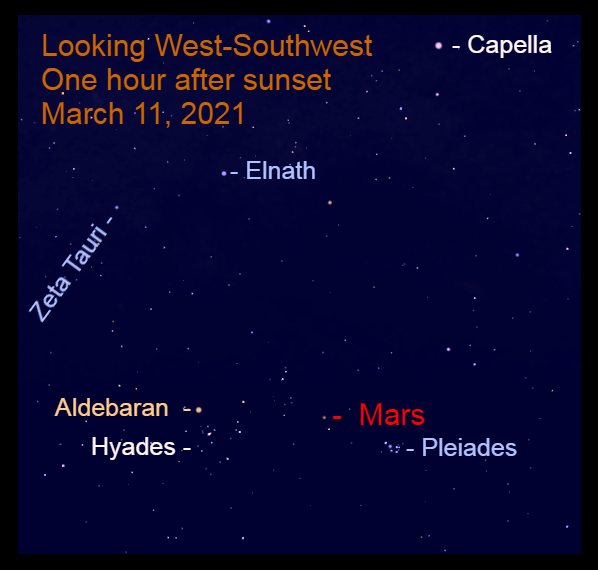
March 11, 2021: Mars continues its eastward march through Taurus. It appears to the right of the star Aldebaran and to the upper left of the Pleiades star cluster.
by Jeffrey L. Hunt
Chicago, Illinois: Sunrise, 6:09 a.m. CST; Sunset, 5:53 p.m. CST. Check local sources for sunrise and sunset times for your location.
Mars continues as the lone bright planet in the evening sky that is less than two-thirds of the way up in the sky above the west-southwest horizon. It is marching eastward in the constellation Taurus.
Mars is nearly 9° to the right of Aldebaran (“the follower”), the brightest star in the constellation. Aldebaran and Mars have nearly the same color and brightness. The planet is now to the upper left of the Pleiades after their conjunction about a week ago.

Use a binocular to see the background stars with Mars. Tonight, the Red Planet is 0.8° to the upper left of 37 Tauri (37 on the chart.)
Here’s more about Mars during 2021.
Read about Mars during March.
Detailed Note: Saturn and Jupiter are easier to see in the predawn sky. They are appearing higher in the sky each morning. Forty-five minutes before sunrise, Saturn is over 8° in altitude above the southeast horizon. Jupiter is over 9° to Saturn’s lower left and about 4° up in the sky in the east-southeast. Fifteen minutes later, Mercury is 4.0° up, 5.4° to the lower left of Jupiter. We say good-bye to Mercury for this apparition. With exceptional conditions you should be able to track it for a few more mornings before it is lost in the sun’s brilliant light. One hour after sunset, Mars (m = 1.1) is less than 60° in altitude above the west-southwestern horizon, among the stars of Taurus. It is to the upper left of the Pleiades and nearly 9° to the right of Aldebaran. Use a binocular to spot it 0.8° to the upper left of 37 Tau.
Read more about the planets during March 2021.
LATEST ARTICLES
- 2026, October 10: New Materials for Energy Supply
 October 10, 2026: Oregon researchers developed a new family of materials to convert light into energy.
 - 2026, October 9: Texas Researchers Modify OK’s Impact Date
 October 9, 2026: University of Texas scientists modify the estimate of a meteorite impact in Oklahoma.
 - 2026, October 8: News From NASA’s Perseverance from Mars
 October 8, 2026: NASA’s Perseverance spacecraft finds unexpected geological strata.
 - 2026, October 7: Predawn Alignment of Jupiter, Moon, and Regulus
 October 7, 2026: Before sunrise, look for Jupiter, Regulus, and Moon align in the eastern sky.
 - 2026, October 6: Crescent Moon Occults Bright Jupiter in Predawn Sky
 October 6, 2026: Watch the waning crescent moon occult Jupiter before sunrise. See disappearance and reappearance times for major North American cities.