
February 11, 2025: At Chicago’s latitude, daylight is again longer than darkness.
by Jeffrey L. Hunt

Chicago, Illinois: Sunrise, 6:51 a.m. CST; Sunset, 5:19 p.m. CST. Check local sources for sunrise and sunset times. Times are calculated by the US Naval Observatory’s MICA computer program.
Daylight is longer than darkness again, as the sun’s daily arc, from east to west, lengthens. What is described here is not the equinox when daytime and nighttime are equal. This year’s vernal equiox occurs on March 20th at 4:01 a.m. Central Time.
Here is a definition of terms:
Daylight is the time when the sun is in the sky. During February, daylight gains 70 minutes, nearly three minutes each day.
Nighttime occurs when the sun is below the horizon. It is a combination of twilight, when the sky is illuminated either before sunrise or after sunset and darkness.
After the end of evening twilight and the beginning of morning twilight on the next calendar day, darkness occurs.
Twilight’s length varies from 3 hours, 22 minutes at the winter solstice to 4 hours, 24 minutes at the summer solstice. Similarly, darkness varies from 11 hours, 30 minutes to 4 hours, 23 minutes at the summer solstice at Chicago’s latitude.
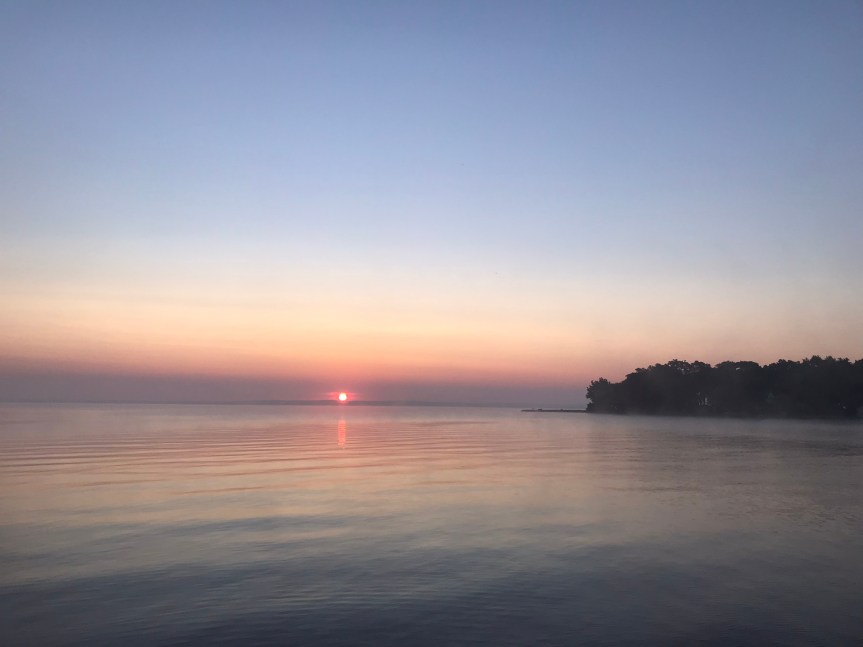
Daylight, twilight, and darkness adds to 24 hours – a day. Today and until Halloween, the daylight’s length is longer than length of darkness.
The interval when darkness is longer than daylight is 102 days at Chicago’s latitude. This period varies by latitude. At Cocoa, Florida’s latitude the period lasts 59 days; Tucson, Arizona, 80 days; Fayette, Missouri, 98 days; Seattle, Washington, 112 days; and Juneau, Alaska, 120 days. The mid-point of these periods is the winter solstice.
As daylight lengthens, enjoy more sunlight and later sunsets.
LATEST ARTICLES
- 2026, November 5: See Four Celestial Objects in the Morning Sky
 November 5, 2026: Find Venus, Jupiter, Mars, and the crescent moon before sunrise. Learn how to spot Spica, follow Mars toward Jupiter, and photograph earthshine.
 - 2026, November 4-7: Watch Venus Meet the Crescent Moon and Spica
 November 4-7, 2026: Watch the waning crescent moon approach Venus and Spica before sunrise. Learn when to see the trio and photograph earthshine.
 - 2026, November 3: Moon, Jupiter, Mars, Venus, and Saturn: Today’s Highlights
 November 3, 2026: Find the crescent moon near Jupiter, Mars, and Regulus before sunrise. See Venus near Spica and observe Saturn through a telescope after sunset.
 - 2026, November 2: Jupiter, Mars, and Moon Gather Near Regulus
 November 2, 2026: Watch Jupiter, Mars, Moon, gather near Regulus before sunrise. This grouping is part of a rare series of gatherings of the three solar system bodies with Regulus.
 - 2026, November 1: Daylight Saving Time Ends: Moon, Jupiter, Mars, and the Planets
 November 1, 2026: Daylight Saving Time ends as the Last Quarter moon approaches Jupiter and Mars. Find Venus, Saturn, Uranus, and Neptune in the November sky.