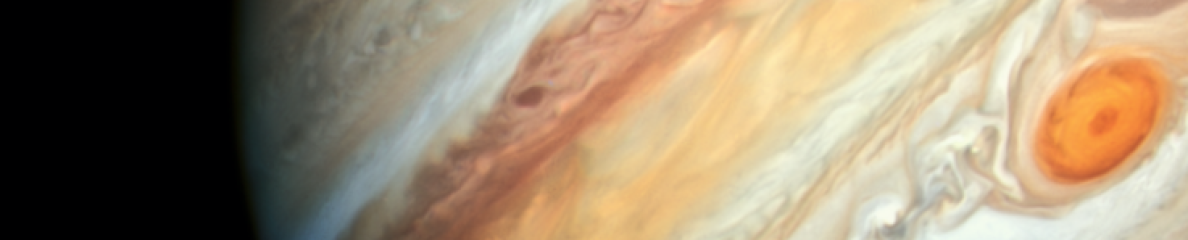
December 7, 2024: Jupiter is at opposition and in the sky all night. The Jovian Giant is part of a four-planet display after sunset.
by Jeffrey L. Hunt
Chicago, Illinois: Sunrise, 7:05 a.m. CDT; Sunset, 4:20 p.m. CST. Check local sources for sunrise and sunset times. Times are calculated by the US Naval Observatory’s MICA computer program.
Jupiter at Opposition

Jupiter is at opposition at 2:58 p.m. Central Time when Earth passes between the planet and the sun. The planet rises in the east-northeast at sunset, appears high in the south around midnight, and sets in the west-northwest at sunrise. Tonight, the Jovian Giant is 380 million miles away.
Jupiter revolves around the sun in about 12 years. Earth overtakes and passes between the more-distant planet and the sun about every 400 days. The oppositions advance about 30° eastward along the ecliptic compared to the previous event.
Jupiter in the Sky at Opposition
After Venus sets 192 minutes after nightfall, Jupiter is the brightest starlike body in the sky. At two hours after sundown, Jupiter is 20° up in the east-northeast.

Jupiter retrogrades in front of Taurus’ distance stars – between Elnath and Zeta Tauri – the Bull’s horns. It is 7.8° to Aldebaran’s lower left, the constellation’s brightest star.
Through a Telescope

If held steadily, up to four of Jupiter’s largest moons are visible through a binocular. At telescopic magnifications of 80x, the quartet appears as stars on either side of the planet. They are along a line that mirrors the planet’s clouds, whipped parallel to the equator from Jupiter’s rapid rotation. More details are revealed with more magnifications such as the Great Red Spot, a long-lived atmospheric disturbance.
Spacecraft Exploration

Eight spacecraft have visited the solar system’s largest planet, starting in 1973 with Pioneer 10. Pioneer 11 followed the next year. Voyager 1 and Voyager 2 passed by Jupiter on their ways out of the solar system, providing the best photos to date and ample images to be combined into movies that displayed the planet’s dynamic atmosphere.

Galileo studied the planet from orbit for eight years, dropping a probe deep into the clouds, before plunging into the atmosphere in 2003.
On its way to Saturn, Cassini radioed over 26,000 images of Jupiter and its moons to Earth that recorded six months of activity.

Juno has studied the planet since 2016. The best photos so far have been sent to Earth. It is expected to continue its study for another year.
The Europa Clipper, launched during October, and the European Space Agency’s Juice Spacecraft are on their way to Jupiter.
Look for Jupiter at Opposition
Step outside tonight to see bright Jupiter against the starry background. Find its moons through a binocular or closer through a telescope. If you are an armchair sky watcher, marvel at the details provided by robot spacecraft.
RECENT PODCASTS
LATEST ARTICLES
- 2026, June 6: Venus Nears Jupiter Before Their Evening Conjunction
 June 6, 2026: Venus closes to within 3.1° of Jupiter after sunset while Mercury joins the evening planet lineup low in the west-northwest sky.
 - 2026, June 5: Venus and Jupiter Tighten in the Western Sky After Sunset
 June 5, 2026: Venus closes to within 4° of Jupiter after sunset while Mercury joins the evening planet lineup low in the west-northwest sky.
 - 2026, June 4: Venus Closes to Within 5° of Jupiter After Sunset
 June 4, 2026: Venus rapidly closes the gap to Jupiter before their June 9 conjunction while Mercury joins the bright evening planet display low in the western sky.
 - 2026, June 3: Venus Closes in on Jupiter as Mercury Appears in Evening Planet Display
 June 3, 2026: Venus and Jupiter tighten toward their June 9 conjunction while Mercury joins the bright evening planet lineup low in the western sky after sunset.
 - 2026, June 2: Venus-Jupiter Conjunction in a Week
 June 2, 2026: Venus rapidly overtakes Jupiter before their June 9 conjunction while Mercury joins the bright evening planet lineup low in the western sky after sunset.