January 12, 2025: Tonight, Earth and Mars are closest. This is known as the closest approach, occurring three nights before opposition.

by Jeffrey L. Hunt
Chicago, Illinois: Sunrise, 7:17 a.m. CST; Sunset, 4:42 p.m. CST. Check local sources for sunrise and sunset times. Times are calculated by the US Naval Observatory’s MICA computer program.
Look for Mars

Mars shines brightly from the east-northeast after sundown. It is the fourth brightest star in the sky tonight following brilliant Venus in the west-southwest, bright Jupiter to Mars upper right, and Sirius the night’s brightest star.
Earth and Mars Closest

Tonight, Earth and Mars are closest, three nights before opposition when Earth passes between Mars and the sun.
Commonly known as Mars closest approach, the planet is nearly 60 million miles away. Near opposition, the planet is near its farthest from the sun.
Mars’ orbit is out of round so that its solar distance varies. In 2018, when Earth passed by, the Martian distance was about 36 million miles, over 25% closer than tonight’s distance. Such perihelic oppositions – when Mars is closest to the sun – occur every 15-17 years.
Now Mars approaches aphelion – the farthest from the sun. At the next opposition – an aphelic opposition – Mars is over three million miles farther away than tonight at the closest approach on February 19, 2027.

Mars is an intriguing planet that first caught our attention with Percival Lowell’s perceive canals, War of the Worlds radio broadcast, and science fiction stories. An armada of spacecraft have passed by, orbited, and landed on the planet. Rovers investigate the planet’s expanses.

Mars through a telescope is somewhat disappointing. It appears as a red-ochre globe. Depending on the closest approach, polar caps can be visible as well as distinct, large features. The planet’s diameter is about half of Earth’s size. At tonight’s distance, the planet is unremarkable through the telescopic eyepiece. Photographs reveal details that are not visible to the eye alone.
Views through a Telescope

The accompanying chart compares the size of the planet at 300x telescopic magnification tonight to its size in 2018. Jupiter’s view is added for comparison.

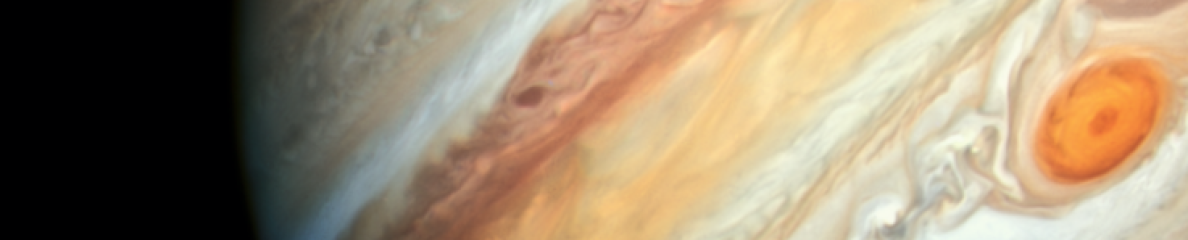
Even though Jupiter is nearly 7 times more distant than Mars and over 20 times larger, it is a spectacular view through the eyepiece. The planet’s rapid rotation whips the clouds parallel to the equator. A long-lived atmospheric disturbance, known as the Great Red Spot, appears and seems to move across the planet from the rotation. The four largest and brightest moons shuttle around the planet. Their changing places are easily observed during a few hours.
Tonight look for the four bright evening planets, starting with Venus and Saturn in the southwest, Jupiter in the east, and Mars in the east-northeast. Mars and Earth are closest tonight for this appearance of Mars.
This evening, Mars crosses the border between constellations Cancer and Gemini.
Tomorrow evening, the moon occults or eclipses Mars for sky watchers in the Americas.
RECENT PODCASTS
LATEST ARTICLES
- 2026, May 9: Last Quarter Moon and Evening Planets, Venus Moves Between Taurus’ Horns Toward Jupiter
 May 9, 2026: See the Last Quarter moon before sunrise and track Venus moving between Taurus’ horns as it closes in on Jupiter in the western evening sky.
 - 2026, May 8: Double Moon Shadows on Jupiter: Venus Shines Nearby in Tonight’s Evening Sky
 May 8, 2026: See the shadows of Europa and Ganymede crossing Jupiter’s cloud tops while brilliant Venus shines lower in the western sky after sunset.
 - 2026, May 7: Venus and Jupiter Dominate May Evenings While a Gibbous Moon Visits Sagittarius
 May 7, 2026: Track Venus and Jupiter in the western sky after sundown and find the gibbous moon in front of Sagittarius before sunrise during May evenings.
 - 2026, May 6: Spring Midpoint Sky: Gibbous Moon with Sagittarius, Venus and Jupiter After Sunset
 May 6, 2026: At spring’s midpoint, find the gibbous moon with Sagittarius before sunrise and track Venus overtaking Jupiter in the western evening sky.
 - 2026, May 5: Waning Gibbous Moon Near Scorpius, Venus and Jupiter After Sunset
 May 5, 2026: See the waning gibbous moon near Antares and the Scorpion’s tail before sunrise, then track Venus and Jupiter in the western evening sky.