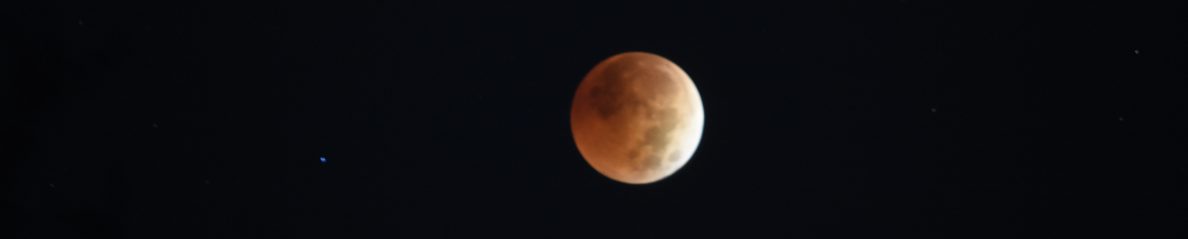

May 26, 2021: Evening Star Venus, Mercury, and Mars are in the western sky after sunset. The Venus – Mercury conjunction is two nights away. Use a binocular to see the brilliant planet and dimmer Mercury. Mars continues its march through Gemini to the lower left of Castor.

by Jeffrey L. Hunt
Chicago, Illinois: Sunrise, 5:21 a.m. CDT; Sunset, 8:15 p.m. CDT. Check local sources for sunrise and sunset times for your location.
After sundown, three planets are visible in the western sky. A close Venus – Mercury conjunction occurs in two evenings. The impending conjunction is the closest until 2033. Over two dozen Venus – Mercury conjunctions occur during the interim, the visible ones – not hiding in bright sunlight and easily observed – are this close.

At 45 minutes after sunset, look for brilliant Venus over 5° up in the sky. Mercury is 2.3° to the upper left of Venus. A binocular is necessary to see the speedy planet and the star Elnath.
Mercury was at its greatest separation from the sun on May 16 and visible to the unaided eye. Each night the planet’s brightness diminished. Elnath is 4.7° to the upper right of this elusive planet.
Tomorrow evening Mercury steps closer to Venus.
Mars nearly 30° up in the west and 26° to the upper left of Mercury. The Red Planet is stepping eastward in Gemini. This evening it is 6.1° to the lower left of Pollux.
To see Mercury and Venus easily, find a hillside or elevated structure that has an open horizon to the west-northwest.
After this morning’s lunar eclipse, the bright moon is about 10° up in the southeast about 2 hours after sunset.
Articles and Summaries.
- Venus as an Evening Star
- Venus Evening Star (Summary)
- Mercury during May 2021
- Mars during 2021 (Summary)
- Mars during May 2021
- Planets during May 2021
Venus sets 79 minutes after sunset, followed by Mercury about 10 minutes later. Mars sets 201 minutes after sunset.
Detailed Note: A total lunar eclipse occurs this morning, although North America and South America do not see the total eclipse cycle that is visible from the Pacific Ocean, Australia and New Zealand. From the Chicago area and nearby locations, this is a disappointing miss. The eclipse begins at 3:47 a.m. CDT when the lunar orb enters Earth’s penumbra. Most observers do not see much darkening when the moon is in the outer ring of the terrestrial shadow. By the time the moon begins to enter the darker umbra, the lunar orb is only 6° up in the southwest. By moonset at 5:27 a.m. CDT, the moon is partially eclipsed, although the sun appears above the horizon at 5:21 a.m. CDT. The official Full phase (Flower moon) occurs during the eclipse, 6:14 a.m. CDT, after moonset in Chicago. Farther west in the US, more of the eclipse is visible. From Sacramento, CA, the moon reaches its greatest eclipse at 4:18 a.m. PDT, when the lunar orb is 14° up in the southwest. The moon begins to exit the umbra only 11 minutes later. At this location, by the time the moon leaves the darker umbra it is near the west-southwest horizon. The moon sets before the moon fully leaves the umbra. Depending on your location during the darker stages of the eclipse, the Milky Way may be visible and certainly dimmer stars in Scorpius region are visible. Jupiter and Saturn are in the southeastern sky. The dimmer stars nearby should be near their normal visibility when the moon is not present. Jupiter is over 26° up in the southeast, while Saturn is about 18° to the Jovian Giant’s upper right. Saturn is retrograding in Capricornus, to the right of θ Cap. It reversed its direction less than a week ago. Aldebaran sets with the sun. Its setting time is one minute different from sunset. The planet trio – Venus, Mercury, and Mars – continues its display in the western sky after sunset. Mercury is nearing the conclusion of its best evening appearance of the year. Begin looking 30 minutes after sunset. Venus is nearly 8° up in the west-northwest. Use a binocular to spot Mercury (m = 1.8), 2.3° to the upper left of the brilliant planet. Fifteen minutes later, Venus is over 5° in altitude and Mercury is over 7° above the west-northwest horizon. Mars is nearly 27° up in the west. By one hour after sunset, Venus is about 3° in altitude and Mercury is nearly 5° up. Mars is in Gemini, 2.3° above δ Gem and 6.1° to the lower left of Pollux. Two hours after sunset (10:15 p.m. CDT), the moon (15.3d, 100%) is 10° up in the southeast, 7.0° to the lower left of Antares (α Sco, m =1.0).
LATEST ARTICLES
- 2026, March 13: Late Winter Sky – Venus, Jupiter, Uranus, and the Crescent Moon
 March 13, 2026: As the Vernal Equinox approaches, daylight nears 12 hours. Venus shines in bright twilight after sunset, Jupiter stands high in Gemini, and Uranus lingers in Taurus near the Pleiades. Before sunrise, the waning crescent moon appears near the Teapot of Sagittarius.
 - 2026, March 12-13: Crescent Moon Passes Sagittarius Before Sunrise
 March 12-13, 2026: A waning crescent moon appears in front of Sagittarius before sunrise. Look for it near the Teapot, passing Kaus Media and occulting Tau Sagittarii from parts of the southeastern United States. A binocular helps reveal the Archer’s faint star pattern.
 - 2026, March 11: Last Quarter Moon, Venus, Jupiter & Uranus Guide
 March 11, 2026: Daylight hours continue converging toward 12 hours across both hemispheres. The Last Quarter Moon stands near Antares before sunrise, while Venus and Jupiter dominate the evening sky. Uranus remains visible near the Pleiades through a binocular, though its viewing window is narrowing.
 - 2026, March 10: Jupiter’s Retrograde Ends
 March 10, 2026: Jupiter’s retrograde ends in front of Gemini near the Twins.
 - 2026, March 9-11: Last Quarter Moon Crosses Scorpius
 March 9-11, 2026: Before sunrise, the waning moon crosses in front of Scorpius near Antares, the brightest star.