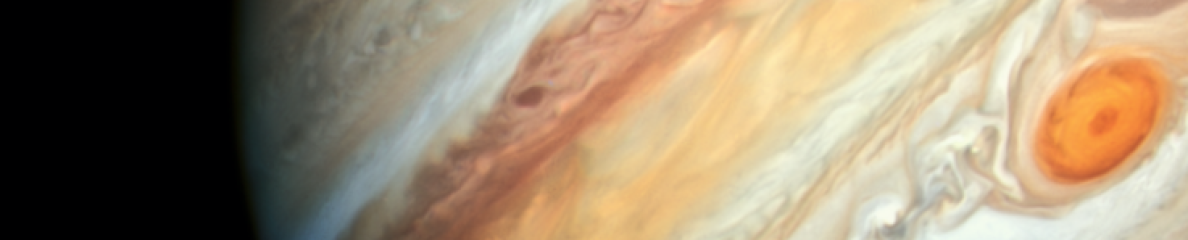

August 19, 2021: Jupiter is at opposition this evening. It shines brightly in the sky nearly all night long.

by Jeffrey L. Hunt
The giant planet Jupiter reaches opposition this evening. At 7:28 p.m. CDT, Earth passes precisely between Jupiter and the sun. This is known as opposition.
Saturn was at opposition on August 2. It appears to the upper right of Jupiter in the evening sky.
Our faster moving planet catches and passes Jupiter every 399 days. As a lead up to the opposition, Jupiter appears to stop moving eastward in its orbit and it seems to back up or retrograde. This westward motion is an illusion from our faster-moving planet.
At opposition, Jupiter (and other planets farther from the sun than Earth) rises in the eastern sky at sunset. It appears in the southern sky around midnight and sets in the west at sunrise. It seems to appear in the sky at opposite times and opposite directions from the sun.

The opposition moment is not important for precise observing. Telescopes are turned toward Jupiter at any time, because it consistently appears large in a telescope eyepiece.
At about 80x through a backyard telescope, the planet is about the size of the number 2 pencil eraser held at arm’s length. On the planetary globe, its cloud stripes are visible and depending on its location, the Great Red Spot may make an appearance. Up to four of its largest moons are easily visible. If held steady, a binocular can see them as well.
On other occasions, one of Jupiter’s largest moons can be seen in front of the planet or disappear behind it. Sometimes the shadow of one of those moons is visible on the planet’s cloud tops.
Near the times of oppositions, astronomers have first observed intricate details of the outer planets, such as fainter moons and features in the planets’ atmospheres.
Along with Saturn, Jupiter is one celestial wonder to view through a telescope at a public star party or through the neighborhood astronomer’s telescope.
Recent Podcasts
Articles and Summaries
- Venus as an Evening Star
- Venus Evening Star (Summary)
- Mars during 2021 (Summary)
- August 2021 Planets
LATEST ARTICLES
- 2026, June 19: Venus Passes the Beehive Cluster While Moon Shines Near Regulus
 June 19, 2026: Brilliant Venus passes the Beehive Cluster after sunset while the waxing crescent moon appears near Regulus. Saturn and Mars remain visible before sunrise in the eastern sky.
 - 2026, June 18: Summer Solstice Nears as Crescent Moon Lines Up with Venus, Jupiter, and Mercury
 June 18, 2026: As the solstice approaches, a waxing crescent moon joins Venus, Jupiter, and Mercury after sunset while Saturn and Mars shine before sunrise. Learn where to look for the planets.
 - 2026, June 17: Daytime Venus Occultation and Evening Crescent Moon with Three Planets
 June 17, 2026: Watch the crescent moon occult Venus during daylight across North America, then see the moon, Venus, Jupiter, Mercury, and the Beehive Cluster after sunset.
 - 2026, June 16-17: Moon Passes Venus, Jupiter, and Mercury During June Evening Sky Display
 June 16-17, 2026: See the crescent moon join Venus, Jupiter, and Mercury after sunset on. Earthshine, the Beehive Cluster, and Mercury’s fading appearance add to the evening sky show.
 - 2026, June 15: Capella Shines in Morning and Evening Twilight While Mercury Reaches Greatest Elongation
 June 15, 2026: Capella is visible before sunrise and after sunset while Mercury reaches greatest elongation near Jupiter. See Saturn, Mars, Venus, and Jupiter in today’s sky.