December 28, 2023: The bright Gemini moon is near Pollux, one of the Gemini Twins. Venus is in the southeast before sunrise. Jupiter and Saturn shine during the evening hours.

PODCAST FOR THIS ARTICLE
by Jeffrey L. Hunt
Chicago, Illinois: Sunrise, 7:18 a.m. CST; Sunset, 4:27 p.m. CST. Check local sources for sunrise and sunset times. Times are calculated by the US Naval Observatory’s MICA computer program.
Summaries of Current Sky Events
Summary for Venus as a Morning Star, 2023-24
Here is today’s planet forecast:
Morning Sky

Bright Gemini Moon
The bright December moon, 98% illuminated, shines from the western sky before sunrise. It is 2.3° to the lower left of Pollux, one of the Gemini Twins. To see the star, block the lunar orb with your extended hand as you would to reduce the sun’s glare.
Four bright stars, Procyon, Pollux, Castor and Capella, form an arc in the western sky.

Venus Steps Eastward
Farther eastward, brilliant Venus shines from the southeast. The planet is stepping eastward in front of Libra, 5.2° to the upper right of Graffias, meaning “the crab, that is part of Scorpius. The Morning Star moves in front of Scorpius in four mornings, passing 0.9° to the upper left of the star on that morning.
The Scorpion is slowly crawling across the horizon into the morning sky. The arachnid’s heart is over 7° above the horizon and 13° to the lower left of Venus. The creature does not fully cross the horizon until March.
Mercury and Mars are moving into the morning sky, although the innermost planet gains seven minutes of rising time compared to sunrise each morning, while Mars gains one minute every two to three days.
Evening Sky
Jupiter

Bright Jupiter is easily spotted in the southeast after sundown. By one hour after nightfall, the Jovian Giant is over halfway up in the sky. Its retrograde ends in two evenings in front of Aries. This evening the planet is 11.4° to the lower right of Hamal, the constellation’s brightest star, and 14.5° to the upper right of Menkar.
When the planet begins direct or its eastward direction again, it slowly approaches an imaginary line from Hamal to Menkar. Watch the eastward progress of the star during the new year.

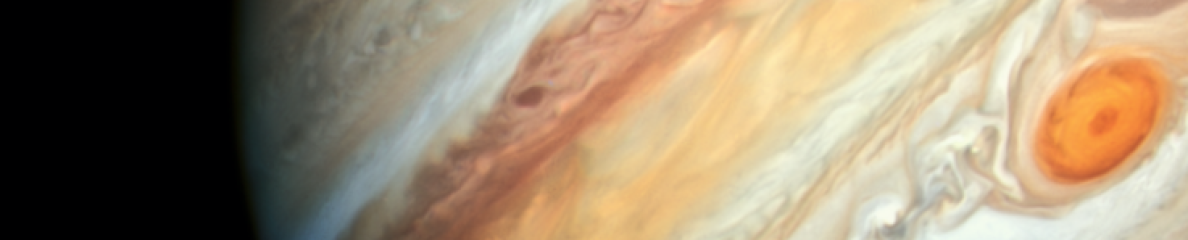
At 6:37 p.m. CST, the planet’s long-lived atmospheric disturbance, known as the Great Red Spot, is at the center of the planet in the southern hemisphere. This is a telescopic observation.
Saturn

Saturn, considerably dimmer than Jupiter, but brighter than most stars this evening, is over 30° above the west-southwest horizon. It slowly plods eastward in front of Aquarius’ dim stars, 9.0° to the right of Skat, the Aquarian’s leg, and 9.0° to the lower right of Lambda Aquarii (λ Aqr on the chart). A binocular is likely needed to see these dimmer stars, especially for urban and suburban sky watchers. The star Fomalhaut, is about 20° to the lower left of Saturn and slightly dimmer. Find the dimmer stars before moonrise.

The bright moon rises almost two hours after sunset and washes out the dimmer stars across the sky. An hour later, the moon is nearly 15° above the east-northeast horizon and 8.1° to the lower left of Pollux. The lunar orb is in front of Cancer, a famous constellation name, but without bright stars. It is a large area between Pollux and Regulus, that rises about five hours after nightfall.
Saturn sets about the time Regulus rises and Jupiter is in the south at this time. The moon is less than halfway up in the east. Jupiter sets nearly five hours before daybreak and about ninety minutes before Venus rises. Look for the bright moon tomorrow morning in the western sky and Venus in the southeast.
RECENT PODCASTS
LATEST ARTICLES
- 2026, May 25-27: Waxing Gibbous Moon Passes Spica While Venus Closes Gap to Jupiter
 May 25-27, 2026: Watch the waxing gibbous moon pass Spica in Virgo while Venus steadily overtakes Jupiter in the western evening sky before their June 9 conjunction.
 - 2026, May 23-29: Venus Overtakes Jupiter During May Evening Sky Display
 May 23-29, 2026: Watch Venus rapidly close the gap to Jupiter with Gemini during late May evenings. Follow the bright planets past Pollux, Alhena, Mebsuta, and other notable Gemini stars.
 - 2026, May 22-24: Waxing Moon Passes Leo While Venus and Jupiter Shine After Sunset
 May 22-24, 2026: Watch the waxing moon move through Leo after sunset while brilliant Venus and Jupiter shine in the western sky. Learn how to find Regulus, Denebola, and the Sickle of Leo.
 - 2026, May 21: Crescent Moon Near the Beehive Cluster with Venus and Jupiter After Sunset
 May 21, 2026: See the crescent moon near the Beehive Cluster after sunset while brilliant Venus and Jupiter shine in the western sky. Saturn appears before sunrise in the east.
 - 2026, May 20: Waxing Crescent Moon Near Jupiter as Venus Brightens the Evening Sky
 May 20, 2026: See the waxing crescent moon near Jupiter after sunset while brilliant Venus shines in the west-northwest. Saturn climbs higher before sunrise as Mercury moves into the evening sky.